When Couples Therapy Stalls: What Keeps the Same Conflict Cycle Going
By Travis Atkinson, LCSW, LICSW

Eight sessions in, Lena* explains the 5-5-5 rule to you.
Five minutes for one partner to talk while the other listens. Then five minutes the other way, and a final five to talk it through together. She has it taped to the fridge.
She is right about the rule. Every Sunday, they use it. They swap “I” statements, take a timeout when voices rise, and stay with one issue at a time. David can summarize her point back to her better than most graduate students.
Then the dishwasher comes up. Within four minutes he has stopped talking, and she is following him down the hallway.
If you do couples therapy or marriage counseling, you know this couple. They have learned what you taught them. On paper, they fight fair. The same fight still arrives on schedule in new clothes: dishes, then money, then his mother, then something said at dinner. Neither of them can remember what was worth fighting for.
You have done good work. Insight lands every week. The same argument loop does not move.
Lena and David are not failing treatment. The argument is real, and the kitchen may well be unevenly shared. It is also only the visible layer. Communication skills help them handle the disagreement, while schemas and modes may explain why those skills vanish when they need them most.
Why do recurring arguments survive good couples therapy?
Recurring arguments survive because the topic keeps changing while the pattern stays put. Couples have the same argument about a new subject every week, and the same fight in new clothes. Skills reshape communication patterns, and the pattern driving the fight was laid down by past experiences long before the couple met.
Couples often repeat conflicts because the pattern is familiar. Familiar feels safer than new, even when familiar hurts.
Gottman’s research found that 69 percent of relationship conflict is about perpetual problems, rooted in lasting differences between partners. Recurring differences are not treatment failure. Trouble starts when a perpetual problem becomes gridlocked: the couple can no longer hold a dialogue about it, and every attempt feels like spinning wheels. Good therapy helps couples tell solvable problems from perpetual ones, and gridlocked ones from workable ones.
Frequent arguing often signals unmet needs or poor communication, and early in treatment, communication is usually the right target. With Lena and David, communication improved months ago. They can talk openly about almost anything, except whatever keeps the fight alive.
Why doesn’t teaching skills end the constant fighting?
Skills change what happens during conflict. They slow escalation, reduce injury, and give partners a way back to each other. Some couples can use every skill in your office, then lose access to all of them when an old emotional threat takes over.
That is the question with Lena and David. They learned the skills. Something switches the skills off.

What happens when a couple can practice active listening perfectly?
Every couples therapist teaches some version of the same toolkit, and for good reason.
- The 5-5-5 rule. Fifteen minutes that balance talking and listening.
- “I” statements. “I felt alone at dinner” reduces defensiveness in a way “You ignored me” rarely does.
- Active listening. Summarizing what your partner said before answering, so each partner can feel heard.
- Timeouts. A short break before escalation, with an agreed time to come back.
- One issue at a time. Staying on one topic prevents kitchen-sinking, where every old grievance lands in tonight’s argument.
- Repair attempts. A joke, a touch, or an apology offered mid-argument to lower the temperature.
- Weekly check-ins. A regular structured conversation keeps small issues from turning into recurring conflicts.
These tools are the backbone of conflict resolution. Counseling helps couples practice new communication skills, and for many couples that work is enough.
Gottman’s research shows why the stakes are high. Criticism, defensiveness, contempt, and stonewalling, which he calls the Four Horsemen, predict poorer outcomes, and contempt predicts divorce most strongly. Frequent arguing erodes trust and connection over time. Repair attempts lower the intensity and protect the bond.
Then there are couples like Lena and David, who practice active listening perfectly on Sunday and lose it the moment the dishwasher comes up.
The skill was never missing. Something switches it off.

What is the conflict cycle beneath the argument loop?
Beneath the content sits a predictable sequence of protective moves. Mapping that conflict cycle helps each partner see what happens to them during conflict, and how their response sets off the other person. As the pattern becomes visible, blame can give way to joint observation. The couple stops asking which partner is the problem and starts studying how the cycle recruits them both. That is why therapists map negative cycles so carefully.
The most familiar is pursue-withdraw. One partner pushes for resolution while the other pulls away. For Lena, raising her voice is an attempt to close an emotional distance that feels dangerous. The same argument follows, whatever the topic. David withdraws because one more raised voice registers as proof he has failed again. His urge to stop talking feels like safety to him and like abandonment to her.
Each partner’s actions make sense from the inside and look like attacks from the outside. Blame meets defensiveness, defensiveness invites more blame, and the reciprocal pattern feeds itself. None of it is about one person being the bad guy.
Recurring fights often mask unmet emotional needs, such as feeling undervalued or feeling unheard. Lena is fighting about the dishes, and she has a point. She is also fighting to matter.
Emotionally Focused Therapy for Couples maps this cycle with real precision, and it helps transform interaction patterns. A 2019 meta-analysis of nine randomized trials found it improves marital satisfaction, with gains sustained at follow-up. The Gottman Method tracks the same moments second by second. I hold certification in both, use them every week, and would not give up either.
Many couples begin to change once they can recognize the cycle together. For the ones who plateau, it keeps running after everyone can draw it on a whiteboard. What powers it?
How do schemas and modes drive recurring conflicts?
Old wounds can be activated by present-day events, which is why a reaction can look far bigger than the moment that set it off. Schema therapy gives you precise names for those wounds and the states they trigger.
A schema is an enduring pattern formed early from unmet needs, then reinforced by later experience. I will be left. Nothing I do is enough. Nobody will be there for me. Abandonment/Instability, Defectiveness/Shame, and Emotional Deprivation show up constantly in couples work. Over years, schemas harden into relationship patterns.
A mode is the state a person shifts into when a schema fires. The Vulnerable Child holds the raw feeling. Coping modes are states that keep that feeling at a distance, and the Healthy Adult can notice all of it while it happens.
Keep the levels separate, because good formulation depends on it. David’s silence is the behavior we can observe. Assessment may reveal a Detached Protector mode, a state where emotional shutdown keeps shame, fear, or helplessness at a distance. Lena’s sharper voice is observable behavior too. Beneath it may be an Angry Child mode protesting the possibility of abandonment.
When a schema fires, the nervous system reacts as if the original danger were back. The other partner reacts to that reaction, and their own schema fires. That mode clash can run in seconds.
The dishwasher is the spark. Abandonment/Instability is the fuel.
Is it one partner’s conflict style, or the cycle?
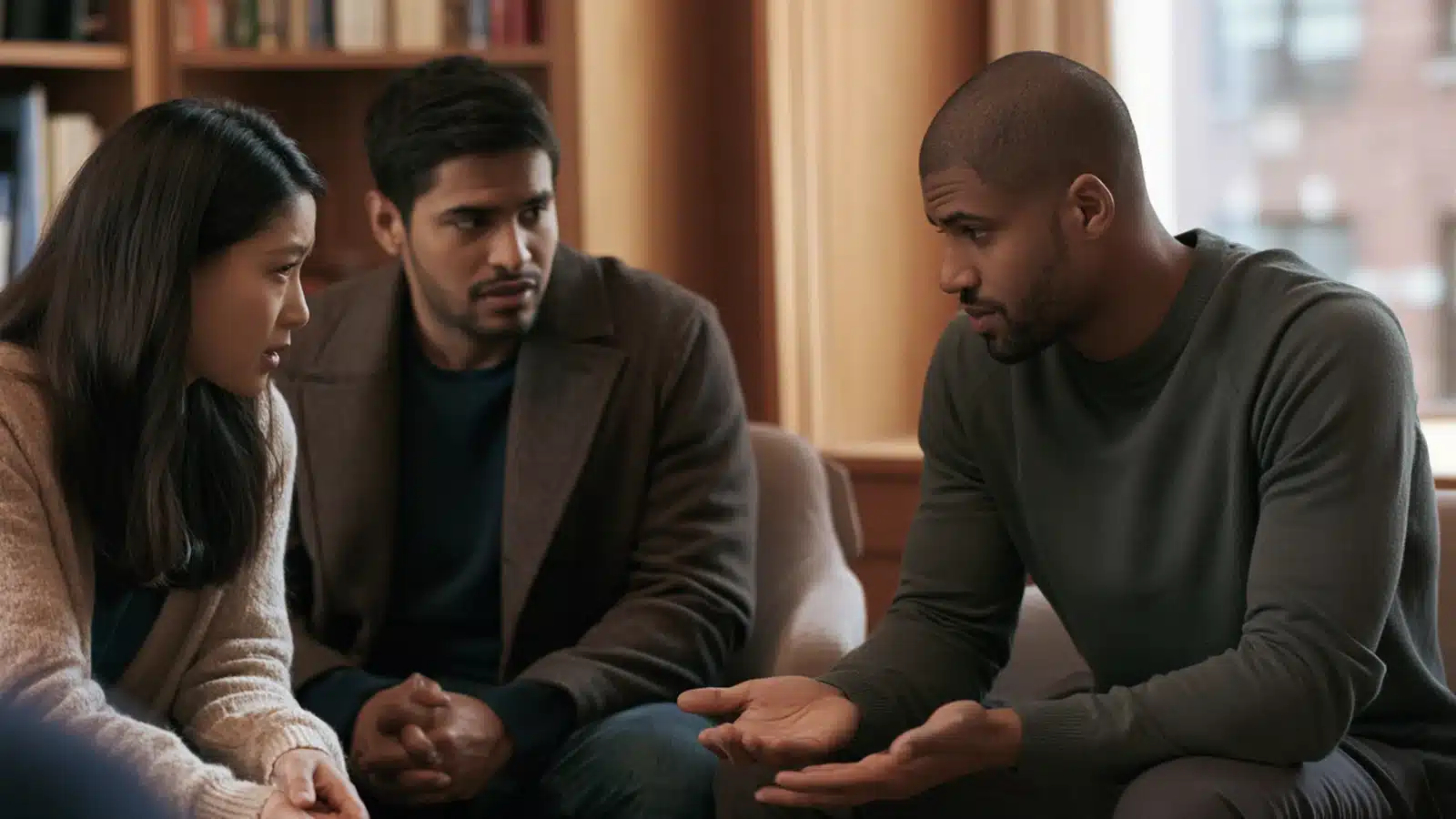
Couples often arrive convinced the problem is one partner’s conflict style. He shuts down. She explodes. The first session usually opens with each person building the case against the other.
Schema work shifts the target. Each conflict style makes sense once you see the schema and mode behind it. When one partner feels criticized, that partner reacts defensively, and the other partner feels dismissed in return. Often the defense is protecting Defectiveness/Shame. Indifference has little to do with it.
Couples therapy then becomes collaboration rather than debate, with two people studying one cycle together instead of arguing about fault.
When enough safety exists, vulnerability can interrupt the cycle in ways another rule cannot. Suppose Lena says “I’m scared you’re pulling away” instead of “You never help.” The Detached Protector has less to defend against. Naming the primary emotion beneath anger often makes a different response possible, because she is voicing her own feelings and deeper needs instead of the latest grievance.
None of that happens without emotional safety. Partners will not risk vulnerability in a room that feels like a courtroom. Your job is to provide a safe space where both people can express what they have protected for decades.

What does a stuck session look like through a schema lens?
Go back to Lena and David. Their household chores are a real dispute, and external pressures make it sharper: David’s job has been shaky for a year. An earlier round of couples counseling quieted the frequent fights. It also quieted the marriage. Repeated conflict over years had turned constant fighting into the silent treatment, and everyone mistook the silence for progress.
A schema lens starts with each partner’s relationship history. Lena’s father left when she was nine, and nobody explained why. An unloaded dishwasher can feel to her like being left alone with everything again. David grew up with a parent who mocked every mistake. A request about the kitchen can land on him as a verdict.
Neither history makes the chores less real, and repeated conflict about them deserves its own solution. Both explain why a ten-minute conversation about them goes wrong in two.
The couples model gives you concrete tools for that moment. Mode Clash Cards help partners catch two modes colliding. Schema Flashcards give each partner Healthy Adult words to use mid-fight. Connecting Dialogues help each person name the core emotion, then the urge to cope, then ask for what they need.
The same layered work shows up in affair recovery. Present-day betrayal needs attention in its own right, alongside the Abandonment/Instability or Mistrust/Abuse schemas it activates. High-conflict couples show a similar shape: an Overcompensator mode on one side keeps meeting a Detached Protector on the other.
What does a session look like with chairwork and imagery rescripting?
Chairwork gives the coping mode and the Vulnerable Child separate seats. A partner can then speak to the Detached Protector directly instead of arguing with all of one person at once.
The first partner speaks from one chair, giving voice to what the protector guards against. Then the child moves to another chair and says what happened. Meanwhile, their partner watches, often hearing the hurt instead of the anger for the first time.
Imagery rescripting works through memory instead of furniture. A partner closes their eyes and returns to an early scene tied to tonight’s schema. The therapist may enter the image, or help the client’s Healthy Adult enter it, to provide protection, validation, or care that was missing. When clinically appropriate, the other partner may witness where the pattern began.
Both techniques take more session time than a skills exercise. They slow the therapy process long enough for the protected experience and underlying issues to emerge, and they can rebuild emotional connection where skills alone have stalled. Once that work is moving, problem solving and conflict resolution tools often land better.
These are among the methods clinicians practice in the Fall 2027 Schema Therapy for Couples cohort. The weekly format gives you time to use a method in practice, examine what happened, and return with a sharper formulation.
When should couples therapy pause for a crisis lifeline or safety plan?
Safety assessment comes before experiential couples work. Coercive control, fear of a partner, dangerous violence, acute suicide risk, or ongoing deception that prevents informed participation may require conjoint sessions to pause.
These are not interchangeable conditions. Some couples affected by substance use or situational conflict can benefit from specialized conjoint treatment after careful assessment. With an affair, the clinical questions concern secrecy, current contact, consent, safety, and whether a workable treatment agreement exists.
Contempt and personal attacks in an otherwise safe relationship are workable. Fear of a partner is different. When one partner cannot speak freely, conjoint sessions can increase danger, which is why the National Domestic Violence Hotline does not recommend couples counseling in abusive relationships. Individual safety planning and specialist support take priority.
If either partner is in immediate danger or a suicidal crisis in the United States, contact the 988 Suicide and Crisis Lifeline or the National Domestic Violence Hotline.
Most couples seek professional help years after the pattern starts. By the time they book a free consultation with a therapist, many feel overwhelmed. A careful first assessment protects the partners and the treatment.
How does schema therapy fit the couples counseling and marriage counseling you already do?
It adds a developmental formulation without asking you to give anything up.
Clinicians trained in Emotionally Focused Therapy for Couples, the Gottman Method, IFS, or marital and family therapy keep the frameworks they use. Whether your practice calls it couples therapy, couples counseling, or marriage counseling, the stuck couples look the same.
Your existing training gives you a head start. If you trained in emotionally focused couples therapy, you already see the cycle. With a Gottman background, you already watch flooding and repair attempts in real time. Clinicians from family therapy already think in systems.
IFS-trained clinicians will recognize a related way of attending to protective states and vulnerable experience. Parts and modes are not equivalent concepts, but the familiar language can be a useful bridge. Schema therapy adds a developmental account of what each protective state expects, fears, and tries to prevent.
Improving relationships rarely means fewer disagreements, and a healthy relationship is not conflict-free. It has healthy conflict. Couples do not need to stop fighting. They need to stop fighting the same fight.

Where can you learn this before your next stuck couple?
The Schema Therapy Training Center of New York runs one Schema Therapy for Couples cohort each fall, and I teach it myself. It is built for clinicians already doing couples counseling, marriage counseling, or family therapy.
The Fall 2027 cohort meets live on Zoom, Wednesdays from 11:00 a.m. to 2:00 p.m. Eastern Time, September 22 through December 8, 2027. There is no session the day before Thanksgiving. That is 11 structured sessions and 33 hours of coursework toward ISST couples certification, in a cohort capped at 20 clinicians.
The rhythm of the week is the method. On Wednesday you learn an intervention and practice it in a small breakout group. By Thursday you are trying it with a couple of your own. You notice where it stalled, where you lost your nerve, where the couple surprised you. Next Wednesday you bring that back for feedback.
That structured environment is where the skill becomes yours. A weekend intensive covers a technique once. Eleven sessions let it get practiced, brought back, and refined, and that pacing makes all the difference.
Each session blends teaching, live demonstration, and breakout practice with feedback on your own work. Recordings stay available for at least a year.
Fall 2027 · Schema Therapy for Couples
Your stuck couples are the curriculum.
Eleven live Wednesdays. Twenty clinicians, at most. You bring the couple who keeps having the same fight, and you leave each week with something to try before you see them again. Applications for the September cohort are open now.
Wednesdays, 11:00 a.m. to 2:00 p.m. ET | September 22 to December 8, 2027 | Live on Zoom
Who teaches the Fall 2027 cohort?
I co-created Schema Therapy for Couples with Dr. Jeffrey Young. Separately, I worked alongside him at his Cognitive Therapy Center of New York for nearly two decades. In 2008, I was one of the original founders of the International Society of Schema Therapy, and ISST named me an Honorary Lifetime Member in 2020.
My couples work draws on three models at once. While schema therapy for couples was taking shape, I was also training at the Gottman Institute, and I have been a Certified Gottman Method Couples Therapist since 2006. Dr. Sue Johnson trained me in Emotionally Focused Therapy for Couples, and I am a Certified Emotionally Focused Couples Therapist and Supervisor. I am also an Advanced Certified Schema Therapist, Supervisor and Trainer.
I serve as Vice President of Media and Communications for the Jeffrey Young Schema Therapy Association. Clinically, I still see couples every week through Loving at Your Best, online from New York City and Fort Lauderdale. My practice has a long history with LGBTQ+ couples, too.
That combination shapes the training. What you already know stays, and the training connects it.
Who should not apply?
A therapist with no couples therapy or marriage counseling caseload will get less from this cohort than one sitting across from stuck couples every week. The format depends on bringing real material back each session.
If you want an introduction to schema therapy itself, start with our individual training program. The couples cohort is best suited to clinicians able to attend and practice consistently across all 11 sessions.
What do couples therapists ask before applying?
Will this ask me to set aside my EFT or Gottman approach?
No. The model sits alongside both, adding a developmental formulation of the cycle. You keep what works and gain another way to reach the couples who plateau.
Do I need prior schema therapy training?
It is not required to enroll. Some familiarity with schemas and modes makes the pace easier, since the cohort moves quickly into couples application.
Will completing this training make me ISST certified?
Not on its own. The training provides the workshop-training component toward ISST certification in Schema Therapy for Couples. Certification also requires educational consultation or supervision, plus recorded clinical work submitted for competency assessment. Confirm the current requirements directly with ISST before you begin.
Is the training live or self-paced?
Live and cohort-based, meeting weekly on Zoom with breakout practice. Recordings support review but do not replace live participation.
Which couples does this help most?
Couples stuck in repetitive arguments: pursue-withdraw cycles, affair recovery, and high-conflict pairs. It also helps when one or both partners feel misunderstood, or keep feeling unheard, despite good skills work. The curriculum includes couples where one partner shows borderline, narcissistic, obsessive-compulsive, or avoidant patterns.
What if one partner is already in individual therapy elsewhere?
Couples work can proceed alongside individual therapy when the roles are clear. With the clients’ consent, limited coordination helps when treatments overlap, risk concerns arise, or imagery and other intensive experiential methods are in use. Coordination should serve a defined clinical purpose, not become routine session-by-session reporting.
How does tuition work?
Tuition is set by country, using cost-of-living tiers, with installment plans available. Details are on our Tuition page.
When should I apply?
Applications for Fall 2027 are open now. Each cohort is capped at 20 clinicians.
What happens to Lena and David?
The dishwasher comes up again.
David looks toward the door. This time, you notice before he leaves.
“Before you go quiet, what did you hear Lena saying about you?”
He hesitates. “That I’ve failed again.”
Lena’s voice softens. “I was asking for help.”
The dishes still need doing, and the unresolved argument about them is still on the table. Now there are two things they can work on: how they share the kitchen, and what happens when a request starts to sound like a verdict.
That moment is learnable. Few parts of the therapeutic process are more rewarding to watch, and few protect the well-being of everyone in the room so well.
If a Lena and David are on your caseload now, the Fall 2027 cohort will help you formulate what keeps their cycle moving. You will practice what to do when communication skills are no longer enough. Improving relationships like theirs is the work we do together for 11 Wednesdays.
Review the curriculum and apply for Fall 2027.
*Lena and David are a teaching case I created for this article, not real clients.
Spring 2027 Schema Therapy for Individuals: Online Training
Interested in deepening your Schema Therapy practice?
Our Spring 2027 training is designed for clinicians who want practical, case-based learning they can integrate into their clinical work.